Built from experience in production decision systems
ARCS grew from experience with enterprise software, large scale systems, high volume payment APIs and rules engines, combined with practical AI development.
Why ARCS exists
AI is increasingly making decisions and taking actions that affect customers, money, operations and businesses.
When those decisions are questioned, organisations need to understand what happened, who was involved and what rules applied. Reconstructing that information from application logs and separate systems can be difficult.
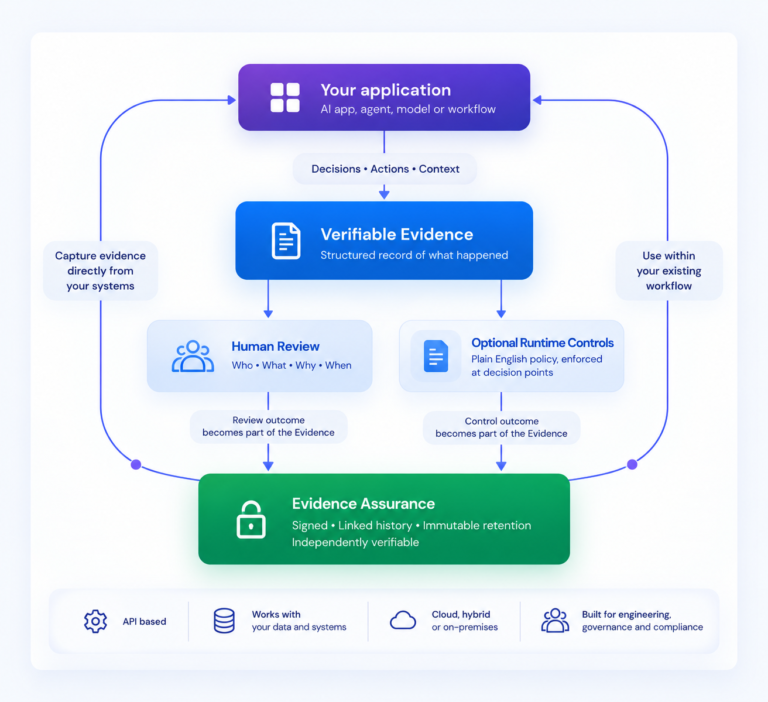
ARCS creates an accountability record as decisions happen, bringing together independently verifiable Evidence, recorded Human Review and understandable technical controls where needed.
Why I am building ARCS
I have spent 18 years developing enterprise software across Intel, IBM, Mastercard and Boeing. Since 2024, I have also been developing AI applications using technologies such as LangGraph, LangChain, RAG and MCP.
That combination of experience has shaped how I think about AI systems, particularly when they become part of important business processes.
My experience spans complex business systems supporting financial transactions, fraud prevention, government services, enterprise analytics and aircraft operations.
Working with distributed applications, APIs, databases, virtual machines and cloud infrastructure has given me a deep understanding of what reliable production software requires: security, performance, scalability, failure recovery and the ability to understand and explain system behaviour.
As AI becomes part of these systems, I believe the same engineering discipline is essential.
AI applications increasingly make decisions and take actions, but the information needed to explain those decisions is often scattered across application logs, model traces, databases and separate approval processes.
When something is questioned, reconstructing what happened can be difficult. Even when logs exist, they may not provide independently verifiable evidence of the decision or who authorised it.
I built ARCS to address this gap, capturing trustworthy Evidence, Human Review and applicable rules as decisions happen, rather than trying to reconstruct the accountability record afterwards.
Let's discuss your AI project
Whether you're looking to introduce AI into your existing systems, build intelligent agents and workflows or improve accountability for AI decisions, I'd be happy to discuss how I can help.
Explore ARCS to see how verifiable Evidence, Human Review and runtime Controls work in practice, or learn more about my AI engineering and integration services.
