A decision authority for AI in production
ARCS is a deterministic runtime enforcement layer for AI systems. It evaluates policy at execution boundaries that carry legal or operational consequences, such as model calls, tool execution, workflow transitions and protocol interactions.
About ARCS Platform
ARCS introduces structural decision authority into AI systems operating in production. Instead of relying on documentation, monitoring or post hoc review, ARCS evaluates policy at the point where decisions are executed.
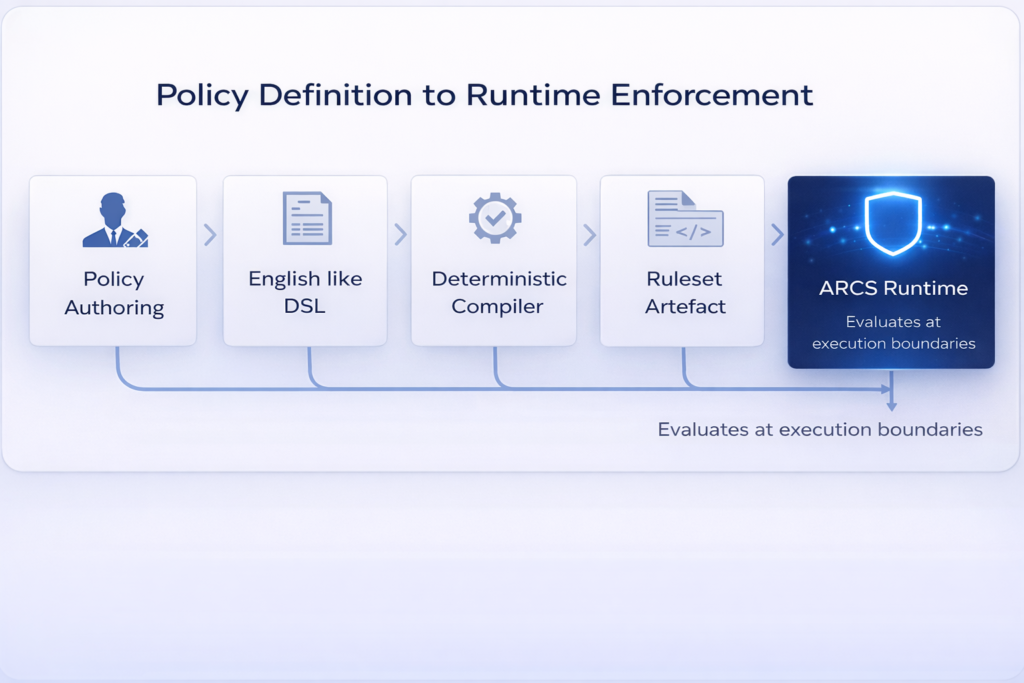
Policies are written in an English like domain specific language aligned to organisational vocabulary. Rules are compiled into deterministic runtime artefacts. Enforcement points are defined before deployment and cannot be bypassed through scattered application logic.
Changing policy does not require retraining models or redeploying applications. Updated rules are compiled into new runtime artefacts and enforced consistently across model calls, tool execution and workflow transitions. The runtime evaluates structured context and resolves decisions deterministically.
Every evaluation emits a structured DecisionRecord capturing the boundary, context, rule path and final outcome. Governance is not only enforced. It is provable.
Architecture Overview
ARCS separates policy definition from runtime enforcement through two deterministic components.
ARCS DSL Compiler
Policies are authored in an English like domain specific language aligned to organisational vocabulary. The compiler validates rules against versioned schemas and produces a canonical Ruleset artefact for runtime enforcement. Compilation is deterministic and versioned to ensure stable, auditable runtime inputs.
ARCS Runtime
The runtime exposes a single evaluation interface:
arcs.evaluate(boundary, context)
At defined execution boundaries, ARCS evaluates structured context and returns one of four deterministic outcomes:
Allow
Block
Modify
Escalate
Every evaluation emits a structured DecisionRecord capturing the boundary, context and rule path. The runtime fails closed by default.
Integration Model
ARCS integrates with existing AI systems while preventing governance bypass.
Framework Interceptor Integration
Register ARCS once within the AI orchestration framework. Execution boundaries are intercepted centrally. Governance logic remains separate from business code.
Network Proxy Enforcement
A mandatory network proxy ensures outbound model and tool calls require valid ARCS authorisation. This prevents runtime bypass of policy enforcement.
In Process Runtime Instrumentation
Where deeper control is required, runtime instrumentation enforces policy before execution boundaries without modifying business logic.
Explicit arcs.evaluate Calls
Where no interception path exists, explicit arcs.evaluate calls can be used. These are restricted to integration layers and not embedded in business logic.
Take Action Now
Join us in championing responsible AI governance and make a difference in today's technology landscape.
